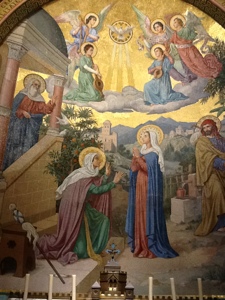
The following is Fr. Matthias Neuman's Homily for the 4th Sunday of Advent.
Readings: Micah 5:1-4; Heb 10:5-10; Luke 1:39-45
Liturgical historians tell us that the season of Advent is divided into two sections. The first runs from the 1st Sunday of Advent to Dec. 16. The main themes of this section encompass a looking forward to the Second Coming of Christ and the repentance needed to prepare for it. John the Baptist shines forth as the primary figure; he dominates the liturgical readings. The second section runs from Dec. 17 to Dec. 24. and especially emphasizes expecting the birth of Christ. Mary, the mother of Jesus, is the dominant personage here.
In this last week before Christmas the liturgy presents Mary through any number of lenses: she is listener of the Word; she is the ponderer who keeps all these things in her heart; she is the exemplar of faith; she is the poor daughter of Israel; she is the great rejoicer in what God has done for the People of Israel. Mary is always front and center as our Mother in many ways.
The key emphasis today lies on Mary as a "woman of faith," particularly signified in the words of Elizabeth: "Blessed are you who believed that what was spoken to you by the Lord would be fulfilled." (Lk 1:45) That is stated so succinctly by Elizabeth that we can often take it for granted. But what’s really involved in that statement? I’d like to imaginatively unpack it.
a. The key insight in the Annunciation account is that Mary came to a faith-filled conviction that she was to be the mother of the Messiah. The Gospels portray that in grandiose fashion by the appearance and announcement of an angel. But likely much of that is literary staging. Mary could just as easily have come to that conviction by her own deep meditation and prayer on the great Messianic prophecies of Micah and Isaiah. If there is to be a Messiah, and she firmly believed there would be, that Messiah has to have a mother. Mary came to the faith-filled conviction that she was the one chosen to be that mother. But what evidence to the contrary!
b. Why should the mother of the Messiah be a simple young Jewish woman with no standing in society? How much more fitting the daughter of a king or the high priest! No, Mary felt it was her and she likely shared that feeling with friends. Some, like Elizabeth, supported her and other probably ridiculed her as a dream-filled young girl. Mary did not know how it would happen.
c. What a shock when she began to miss her periods. How can this be? She’s never had relations with a man. Is it perhaps a false pregnancy, a sign of delusion? She had to be scared. And then the first time she felt the infant stirring within her, she knew it was real.
d. Then gradually she began to show the pregnancy. She had become betrothed to Joseph and she probably wondered how that would fit in with the pregnancy she carried. More doubts and wonderings, but her faith pulled her through. One can imagine the snickers of others and the jokes about Joseph. And yet Mary carried on in faith despite the derision.
e. Finally, visibly pregnant, she makes her journey to her cousin, Elizabeth, to assist her in her aged pregnancy----an act of love undertaken out of her own faith.
At last Mary’s faith receives some strong support and confirmation. Elizabeth assures her, "Blessed are you who believed that what was spoken to you by the Lord would be fulfilled." I like to imagine that Mary leaned over to Elizabeth and whispered, "It hasn’t been easy." Mary, our exemplar in faith.
Sunday, December 20, 2009
Blessed Are You Among Women
Friday, December 18, 2009
Fr. Matthias Neuman's Reflection for our Reconciliation Service
Readings: John 1:1-13
The opening word of the Rule of Benedict is that famous word, Ausculta - Listen or Hear intently. To benefit from all that is written afterwards in the Rule the aspiring monk must be in a frame of mind that is attentive and open. The same might be said of the words of the scripture passage we have just heard: Listen, "In the beginning was the Word." Unless we are listening carefully, we will never hear the Word.
Social scientists have often observed that it is getting harder and harder for people to listen intently in our society. Simply because most people live in contexts with multiple sources of extraneous noise, either willfully chosen (headsets and ear phones) or socially produced (interstate highways and airports). We do live in a society where people are surrounded with almost constant noise. That makes it extremely difficult to hear any word in depth—much less the revealed word of God. And yet that’s the challenge of this Christmas season: to hear the meaning of the Word-made-flesh for our lives.
This reconciliation service should be a step in preparing ourselves to hear that Word-made-flesh. It’s a step towards reducing the noise in our lives. Sometimes that noise can be exterior (the paging call and loud conversations in the monastery hallways) and sometimes it may be interior—concerns, distractions, passions that can dominate our awareness to the point where we can think of nothing else and are not ready to hear the Word-made-flesh.
One area that often creates internal noise in us is covetousness. Covetousness may be inbred in our being born as self-centered children. A couple of evenings ago I was talking on the phone with my niece in Knoxville, TN. She has two boys, ages two and four. As we were conversing, in the background I could hear a series of high-pitched shrieks. I asked what was going on. She answered that the two boys were engaged in sibling rivalry. Evan, the two-year old, would stand in the middle of a veritable forest of toys and be interested in absolutely nothing....until his older brother picked up a toy. Then Evan had to have that toy; he would run to it, grab it and would shriek until he got it. Even after Colin, the four-year old, gave it to him, Evan’s interest in the toy lasted only until Colin picked up another toy. Then Evan would throw away the first, grab the second and the shrieking process would begin all over. We would like to think that we have overcome such infantile covetousness. But think again. How often it is that we have no interest in some things....until someone else in the community receives that item as a special gift or permission. Then our desires are piqued. Maybe our expression is flowered over with all sorts of adult rationalizing, but deep down it’s still the same old covetousness. And it creates tremendous noise in our inner lives.
This reconciliation service should be a very intense listening to the word of our own lives, to discern where we have need of repentance and reconciliation with God so we can truly listen, free of inner noise, to the Word-made-flesh. It’s time to erase some of the internal noise in our lives.
Wednesday, December 16, 2009
Fr. Matthias Neuman's Homily for the 3rd Week of Advent
3rd Sunday of Advent - Dec. 13, 2009
Readings: Zeph 3:14-18; Phil 4:4-7; Lk 3:10-18
In the pre-Vatican II years this Sunday was always known as Gaudete Sunday—Rejoice Sunday, from the opening Antiphon at Mass (Gaudete in Domino semper; iterum dico gaudete. Rejoice always in the Lord; again I say, Rejoice). This Sunday has a very special meaning for me, but I have to give you a little background to explain. In 1966 we at St. Meinrad were just beginning to make some of the liturgical changes that had been mandated by the Second Vatican Council’s Constitution on the Liturgy. It was a traumatic time for many in the community. One of those changes was that much more attention needed to be given to the homily at mass. The monastery liturgy committee decided that we would have a homily every Sunday and on several days of the week, depending on the feast days that week. This was a daunting task for many of the priests and they did everything they could to get out of it. I, on the other hand, in 1966 was a newly ordained deacon and just chomping at the bit to preach. (It was the brashness of youth.) I ended up preaching quite often, because many of the priests who didn’t want to asked me to be deacon for them. One of those Sundays was Gaudete Sunday, 1966. It was the occasion of the homily that caused me to be banned from any further preaching in Abbey Church.
What did I say that caused me to be banned? I suggested that expressing joy is a more fundamental attitude in Christian life than bearing suffering. (After all, it is through the suffering of the cross that we come to the joy of Resurrection.) That was way too much for some of the older fathers to take. That gives you some idea of how far the Catholic Church has come in the last forty years. To say that expressing joy is more than bearing suffering would hardly raise an eye brow today. Forty years ago that statement was an occasion of scandal. Back then the necessity of suffering was deeply engrained in the Catholic consciousness. One vignette says it all. I was standing in line in the duplicating room at St. Meinrad waiting my turn for the Xerox machine, which in 1971 was the wonder of the age. One of our older fathers was in line ahead of me. He turned around and asked if I was doing something for a class. I said, "No, it’s for a program that I’m doing at St. Joseph’s parish in Jasper." He looked at me sternly and said, "Tell them to suffer. And if they won’t suffer by themselves, then you make them suffer." It’s a much different Catholic mood forty years later.
Or is it? While we often give lip service to joy and rejoicing, how often do we really express open and unrestrained joy? When we rejoice, do we let our hearts go openly and completely? Or do we say, "Well, a little, but not too much." We still almost instinctively hold back from committing ourselves too completely to anything. I don’t think there’s much doubt that the prophet Zephaniah was calling for full and unrestrained joy when he wrote: "Shout for joy, O daughter Zion! Sing joyfully, O Israel! Be glad and exult with all your heart, O daughter Jerusalem!"
The fact of the matter is that we are all still learning to be joyful people, people of Resurrection joy. As we look forward to joyfully celebrate the birth of Christ, let’s make sure it’s a step in the right direction, a step towards learning and expressing a complete joy of our heart for what God has done for us.
Tuesday, December 15, 2009
Bishop Etienne's Coat of Arms
This is Bishop Paul's Coat of Arms. The left side represents the Diocese of Cheyenne. The right side represents the following: At the top is a river, representing the rivers that have passed through his life; The Ohio (Tell City), Tiber (Rome), Potomac (Washington, D.C.), Mississippi (St. Paul), White (Indianapolis), as well as the living stream of life, Jesus Christ. The tree represents both the Etienne and Voges families; the early generation of Etienne's were loggers, and the Voges family carpentry and construction; as well as the tree of life, the cross of Jesus Christ. The sword is for St. Paul, and the book represents the Sacred Scriptures and Preaching. The M is for Bishop Etienne's devotion to the Blessed Mother. The Sun symbolizes Christ, the Dawn from on High, as well as his general love of the outdoors.
Monday, December 14, 2009
Bishop Bob Lynch's Homily
Bishop Paul became friends with Bishop Lynch shortly after he graduated from college. Paul was asked to be the assistant coordinator of the Papal Visit. This was a short term job that was created to prepare for Pope John Paul II's visit to the United States in 1987. Though the job was short term...a long lasting friendship begun. The following is the homily Bishop Lynch gave at Paul's Ordination/Installation.
I wish to begin by expressing my thanks to soon-to-be Bishop Etienne for giving me one more opportunity, perhaps this time finally to get it right – having been accorded the privilege of preaching his first Mass as a priest eighteen years ago, I also wish to acknowledge my gratitude to Archbishop Charles Chaput to whom this special moment would be normally be given.
“For my yoke is easy, and my burden light.”1 These words of the Evangelist Matthew in the Gospel just proclaimed are at one and the same time comforting and challenging. The office of bishop in Christ’s church has undergone some major changes in both job description and perception in my lifetime. The expectations of the Catholic faithful of Wyoming this afternoon are great and if you will allow me to continue Dickensonian language, we are both in the “ best of times and [at least according to TIME magazine] the worst of 1 MT 11:30 2 times.” They call for episcopal leadership which is positive, hopeful, inclusive, collegial, humble and faithful.
Scripture is not a great help in defining the expectations of a bishop. However St. Paul, whose name you and your father carry, in the pastoral epistles speaks of bishops in only two instances. In one he counsels the bishop to take no more than one wife [not particularly helpful advice this afternoon] but then continues that the bishop should also be of “even temper, self-controlled, modest and hospitable. He should be a good teacher. . . .He ought not to be contentious but rather gentle, a man of peace.”2 In his letter to Titus, Paul repeats his qualifications for the office of bishop and adds this timely reminder: “The bishop as God’s steward. . . [must] in his teaching hold fast to the authentic message so that he will be able both to encourage men to follow sound doctrine and to refute those who contradict it.”3 So there my dear friend Paul, and the Church of Wyoming is the core of the job description for a bishop, then and now. 2 1TIM 3:1-3. 3 TITUS 1:1-9
So your name sake sets a high bar and defines the nature of the yoke soon to be placed on your shoulders. I know since we spoke about it that you were captured by Archbishop Sambi’s talk at last month’s bishops’ meeting in Baltimore that the bishop should have three requisite qualities: fidelity which allows for an appropriate application of creativity, prudence and a positive approach to Episcopal leadership which gives hope to a people often struggling.
Not only will the Lord lighten the burden of office, but your brothers in priestly ministry will be an enormous help to you. Quite frankly, we can not administer the Church without our good priests and they will look at you from varying perspectives. To some you will be a “father” and to others “a brother” and perhaps to some, even a “bother.” But you must listen to them carefully, dismiss their advice cautiously, if ever, and consider them always your closest collaborators in ministry.
While the Church in Wyoming does not have a large number of deacons and religious women and men, they too are a part of the mosaic of ministry you will find here, Paul. And the Church which is not yours or mine, but belongs first to Christ and then to the baptized. Good people of the Church of Cheyenne be patient with your new bishop. Archbishop Buechlein and I can honestly attest to you that there was to be found no trace of ambition in Father Paul Etienne. Becoming a bishop was the farthest thing from his mind. He has spent 18 years becoming a good pastor, spiritual director and servant leader. When he learned from Archbishop Sambi that the Holy Father wished to name him to be bishop of Cheyenne, he was floored. When it was safe to do so he called me one night and we talked about what was coming in his life. Just before he hung up, he said, “you know Bob I know nothing about what I will need as a bishop – what to wear. I don’t even own a rabat vest. And someone said I needed a ‘coat of arms’ and I have no clue what should go on it.” Remembering a Monday several years ago when I called his cell phone, only to be answered by the ear splitting sound of a rifle being discharged and Paul saying, “got to hang up, Bernie and I just shot ourselves a deer” I could not help but tell the soon-to-be new bishop that perhaps in one corner of his coat of arms he should have a dead deer and choose as his motto, “like a deer that once longed for running streams.” The Etienne three brothers gave each other hunting rifles for priesthood ordination gifts and I have been wondering if Episcopal ordination warranted something bigger still, like a bazooka.
So soon-to-be Bishop Paul, the great expectations which everyone has here today and the challenge of the Pauline adjectives can be met if you just remain yourself, comfortable with who you are. There is no role to be played, but rather a ministry of loving service to be lived out. Be humble. Be what you have been which led so many to write in favor of your possible appointment as a bishop. Be the same pastor and brother that has led so many of your brother priests from Indianapolis to fly the long distance to hand you over to another Church. Be the pastor whom people in all the parishes which you have served who said farewell to you in tears these last few weeks will long remember. On the darkest of days which hopefully will be few, look at the crucified Lord and know that compared to His, your burden is indeed light.
I end with deeply personal reflection which perhaps is somewhat inappropriate for a moment like this. In August of this year I struggled to hold on to a slender thread of life. In the ensuing four weeks in intensive care I asked myself over and over again and asked the Lord, “why me? why didn’t you take me to you Lord.” Today I feel I finally know a possible reason and I can in faith repeat the words of Simeon: “now Master you have kept your word, you may [if you wish] dismiss your servant in peace.” Church of Cheyenne, God’s holy people, brother priests and deacons. It will not take you long to discover how lucky you are. With the Lord help this man shoulder the yoke of office and help it be lightened for him so that the Gospel promise of today will also be your experience.
In all things, may Jesus Christ be praised. Amen.
The Ordination/Installation of Bishop Paul D. Etienne...Day 3
December 9, 2009...the day finally arrived! The Etienne Family woke up early on Paul's Ordination day. We drank coffee, ate breakfast and prepared for the long day ahead of us. Many of us had to go to the Civic Center for an early morning practice. I was so impressed with how calm and peaceful everyone was. There was no outer anxiety whatsoever. The practice lasted less than an hour.
After the practice we met at 11:00 for a brunch with family and friends. It was great seeing so many people from New Albany, Tell City, family, priests, bishops and a cardinal. I also met new friends from the State of Wyoming. Once again we were greeted with hospitality and love. After the brunch everyone headed to the Civic Center.
The atmosphere was charged with excitement and anticipation. I was happy to have a few minutes with my friend to chat about everything that had happened up to this point. Finally it was time to return to our seats. The ceremony began promptly at 2:00...4:00 Indy time.
The procession began! Monks, seminarians, deacons, priests, bishops and Cardinal Mahony processed in. The choir was singing and our hearts were pounding with many different emotions. The ceremony had begun!
The first few minutes I was slightly distracted because I knew soon I was going to walk up on the stage and read the First Reading. I had only read the reading once...earlier at the practice. I was nervous. My brother, Bernie, told me a day earlier that I sounded like a teacher reading to her 1st graders when I read for a mass we had at Paul's residence. I didn't have time to read the reading aloud so I was concerned that I would sound more like a teacher instead of one proclaiming the Good News to God's people! Once my task was over I was much more relaxed and was ab
le to totally enter into the ceremony.
When it came time to anoint Paul I no longer felt like I was in a Civic Center...I felt like I was in the House of God. Archbishop Chaput did the Ordination. My first rounds of tears happened while my brother was prostrate on the floor and the choir sang my favorite version of the Litany of Saints. I envisioned every Saint and Angel hovering over my brother blessing him with all that he was asking for during this time of pray
er for him.
Soon it was time for the anointing. Archbishop Chaput poured the Chrism on Paul's head and blessed him. Scripture was placed above his head and the Holy Spirit was once again called upon to enlighten Paul as he promised to carry out the mission of the Apostles in spreading the Good News.
Paul was given a
Bishop's ring, miter and crosier. The Papal Bull was read by Archbishop Sambi. He was lead to the Bishop's chair and sat down. My brother...was now a bishop!
Bishop Paul made his rounds around the Civic Center blessing everyone. Each section of the center exploded in applause as he blessed them...another moment of tears. After the blessing he proceeded to say mass. I was amazed that he was able to say mass after such an emotional experience. Another touching moment was when my niec
es and nephew carried up the gifts. Paul had a huge smile on his face as he received the gifts.
After Communion was distributed Bishop Paul addressed the congregation. He wanted to thank everyone who had made this day possible. He started by recognizing my parents. Mom and Dad stood...as did the entire congregation at the Civic Center! Mom and Dad were given a standing ovation...the third time my tears fell freely! I was so proud to be a part of the Etienne Family.
After the Ordination and Installation our third and final banquet was held. I spent most of the evening talking to friends, family and new friends from Wyoming. It had been an amazing experience. One I'll never forget. Day three came to an end...
Sunday, December 13, 2009
Profession of Faith...Day 2
December 8th, the Feast of the Immaculate Conception, greeted us with snow and high winds. We were anxiously awaiting the arrival of the rest of our family, brother Rick and sister Angie and their families. They flew into Denver and then rented a 12 passenger van to drive up to Cheyenne. We had concerns that maybe the weather would prevent them from arriving in time for the Profession of Faith Prayer Service scheduled for 2:00 in the afternoon. God however, was in charge, and the rest of my family arrived in time for lunch and the prayer service.
The prayer service was held at St. Mary's Cathedral. Bishop Daniel Buechlein was the presider. Bishop Gettelfinger, the Bishop of Evansville, was also present along with Cheyenne's retired Bishop, Bishop Hart. This was a very important service because Paul signed important documents that were essential in ordaining him Bishop of Cheyenne. Scripture was read, a homily was given, importan
t church documents were read and then the necessary documents were signed. Paul had a few closing remarks...that brought tears to the eyes of everyone...and then a final blessing was given.
Friends and family were invited to celebrate the Holy Day Mass. We gathered and worshipped together and then enjoyed a relaxing banquet together at the Little American Hotel in Cheyenne. Again, many stories were shared as the atmosphere was filled with laughter and a few tears. We were so touched by the hospitality shown to us by the beautiful people of Wyoming. We were treated like royalty. My nieces and nephew felt like celebrities.
After the banquet several friends visited us at the Bishop's residence. We continu
ed the stories and laughter. Friendships were deepened, renewed and made. God was ever present in every aspect of the day. It was soon time for the day to end. We said good bye to our friends and good night to one another. The end of day 2 was upon us.